Soldering Sterling Silver
Jump Rings
Soldering sterling silver jump rings for home jewelry making can be done with a small butane torch.
Silver solder is used to permanently join sterling silver or silver rings.
Silver solder can be purchased as wire, paste or sheet.
Sheet solder is generally cut into small chips called pallions.
Paste solder is more expensive than sheet or wire, it does not require flux as it is contained in the paste.
Three grades of solder are available for the above types of solder.
Hard: Generally used as a first step where multiple joins are to be made.
Medium: Used mostly where only one or two steps are required.
Easy: For attaching findings or as a final step.
These operate at different temperatures, with hard being the highest temperature required to complete a join.
These different temperatures are needed when making a piece that may have multiple joins and you wish to prevent earlier soldered jjoints from melting.
It is difficult to quantify exact melting temperatures as various makers have their own specifications.
If purchasing the three grades buy from the one maker.
That is not to say you can't use a different make on part of your project if needed.
You will also need an appropriate flux where neceasary to apply to the metal to ensure a good join.
Sterling silver will develop fire scale from the heat of the torch.
This is a black discoloration of the metal.
When using argentium silver this will not be a problem due to its resistance to scale.
You will need to purchase a jar of "Pickle" available from your supplier to drop the completed sterling silver items into the liquid to remove any scale.
Follow the directions, as this may need to be heated prior to use.
Special pastes can be applied to minimize fire scale problems.
Butane Torch
It is necessary to use a torch to reach the melting point required to close the join.
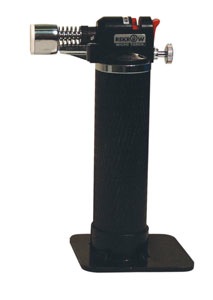
Given the small nature of jump rings, re-chargeable butane torches can be used to carry out this operation.
You will find a number of torches and kits available, which are advertised as being suitable for this type of small work.
There are of course more expensive multi-fuel torches with a selection of tips and capable of carrying out a wide range of work.
If using a butane torch do not use old fuel, as some cheap fuels do not put out the necessary heat.
Preparation:
The metal you wish to join must be clean and free from holes and gaps, as solder will not fill gaps.
Firstly sand the metal surfaces with 400-grit sandpaper to ensure they are completely clean.
Apply flux to the metal areas you wish to join.
If you have more than one joint use hard first, then medium, and soft if necessary on the other joints.
Sometimes you may need to apply anti- flux to prevent solder flowing from previously completed joins.
Using The Torch:
It is most important to remember that solder flows towards heat.
Ensure jump ring is completely closed then place a pallion on your work surface.
Flux the ring and pallion; place the jump ring on top of the pallion.
Heat the jump ring from above by moving the torch around the ring, the melted pallion will be drawn through the joint and the ring will be closed.
Drop your work in a jar of pickle to remove fire scale.
Precious Metal Clay or Art Clay can also be joined this way after appropriate finishing.
If you wish to make a bezel for a fused glass cabochon there are a series of YouTube videos on bezel making.
Return From Soldering Jump Rings To Chain Maille Jewelry
Return To Home Page


