Controlling Glass
Volume
Glass volume control is a method of dealing with shape distortions that can occur during the glass fusing process.
When heating fusing glass to a full fuse in a glass kiln a single stack of glass will try to melt to a thickness of about 6mm or 1/4 inch thick. Unless a dam or some other method restrains it the glass will naturally flow to this thickness.
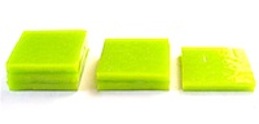
An understanding of this process will enable you to plan your glass jewelry and other designs to use volume control concepts. In the photo below I have arranged three stacks of 3/4 inch squares of glass, which will be fired together at normal fusing temperature in a glass fusing kiln.
In the second photo the fusing process has been completed and the fused glass squares have changed shape.
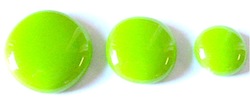
It will be notede that the single layer has pulled in and become a nice small button and is now about 5/8 inch wide.
The 2-layer stack is now slightly larger than its original 3/4 inch width.
The 3-layer stack has spread out as it seeks to reach a 1/4 inch thickness; it is now just over 1 inch wide.
The glass movement can alter the outcome of your designs and needs to be considered when you are planning your glass jewelry piece.
Softening Temperature
Some glasses will soften quicker than others and can affect the final shape.
Black glass will soften before white glass and will begin to flow before white glass. If placed on top of white glass it will spread out before it sinks into the white glass.
White glass placed on top of black glass will sink into the black glass rather than softening and spreading across the black glass.
Knowing how certain colors behave will assist you in planning your fused glass projects.
Design Effects
In simple terms, glass thinner than1/4 inch (6mm) will contract and glass thicker than 1/4 inch (6mm) will flow out.
If you have thick pieces of glass on the edge of your fused glass jewelry piece then the edges will flow out and you may finish with a large and uneven object.
If you have an edge layer of only one thickness then the edges may pull in so than the perimeter is distorted.
When designing jewelry pieces of varying thickness try to ensure that the edge thickness is even to minimize distortions.
Return From Glass Volume Control To The Glassworks
Return To Home Page


